PolloIQ

AI Powered Marketing Insights Dashboard

PolloIQ Hero

Built a working AI agent that pulls real marketing data, generates actionable insights, and presents them through a user-friendly dashboard designed in Figma and built using an agentic framework and Antigravity-driven logic to translate raw marketing data into prioritized business actions.

My Role

Lead Product Designer & AI Workflow Architect

Team

Independent Project

Tools

Figma, Claude Code, OpenAI, Vercel, Github

Marketing teams often struggle to consolidate metrics from ads, social media, and email campaigns into actionable insights. The challenge was to build a fully functional AI-powered dashboard, ingest real data from Google Sheets, analyze it via AI, and surface recommendations in a usable dashboard.

The Approach

To address the challenge of scattered marketing metrics, I focused on designing a workflow-driven solution powered by AI and automation. The approach combined UX research, product strategy, and hands-on prototyping utilizing Antigravity and .md-based rule-sets to define specialized 'Skills' for marketing data retrieval. This agentic approach reduced decision-making time by 20% by presenting 'Next-Step' recommendations instead of raw charts.

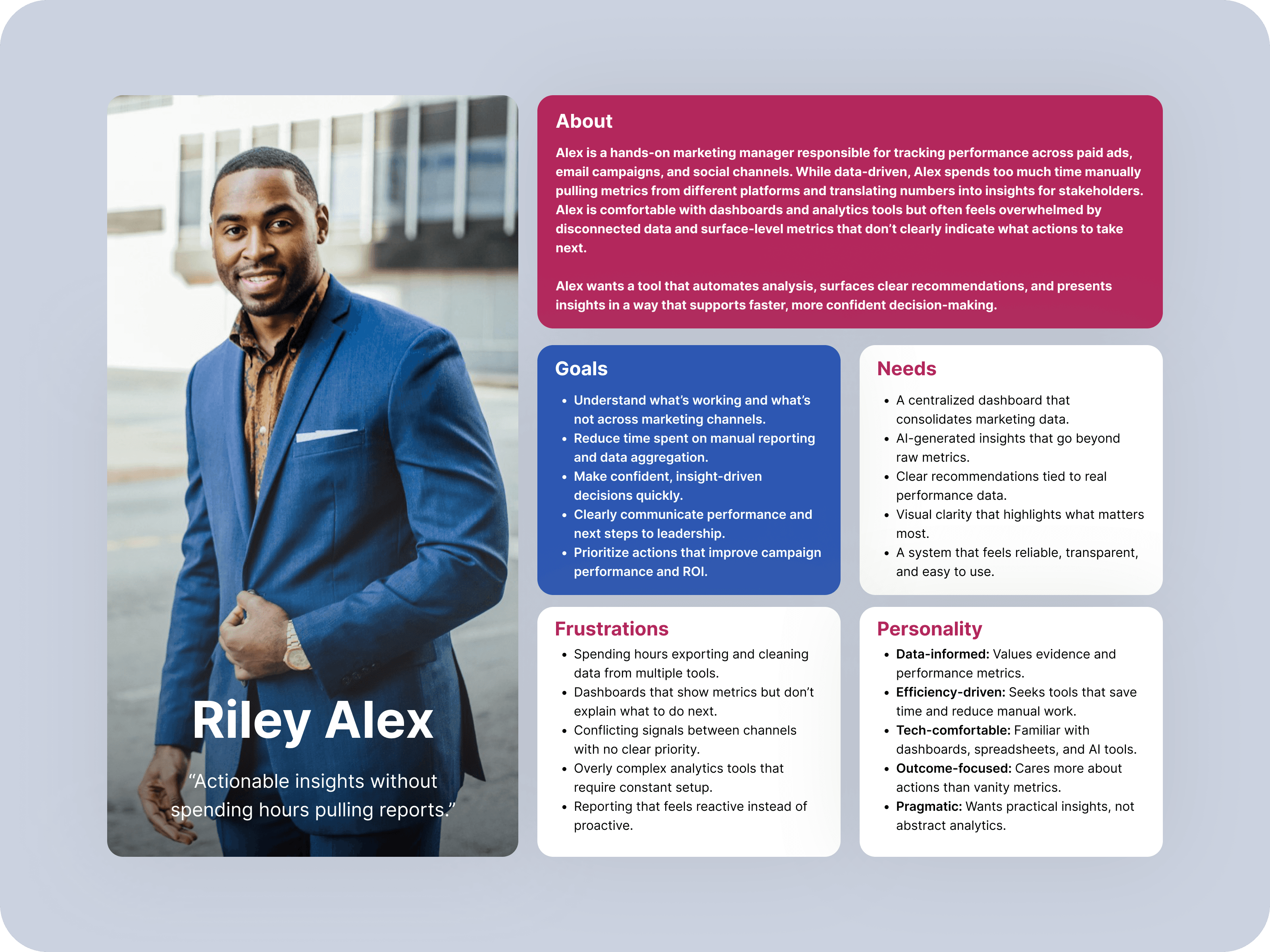
PolloIQ persona

Research & Discovery

The research phase included competitive analysis of leading marketing dashboards such as HubSpot, Supermetrics, and Data Studio to identify UX/UI patterns, and informal interviews with marketers to uncover pain points. Key insights showed that users spend significant time aggregating and interpreting data, and actionable, automated insights improve confidence and efficiency.

To address the friction identified during discovery, I developed a workflow-centered product strategy focused on autonomous data orchestration. In this model, raw data from Google Sheets or CSV files is processed through an agentic pipeline—utilizing OpenAI for analysis and Antigravity-driven logic for prioritization.

The final experience surfaces these insights as clear, actionable recommendations on an interactive dashboard. This strategy was designed to validate the hypothesis that AI-driven insights would significantly accelerate decision-making and reduce manual reporting effort by ~20%.

Research highlights:

  • Users struggle with scattered data and time-consuming manual reporting.
  • Automation and AI can streamline reporting while maintaining clarity.
  • Delivering actionable insights increases user confidence and efficiency.
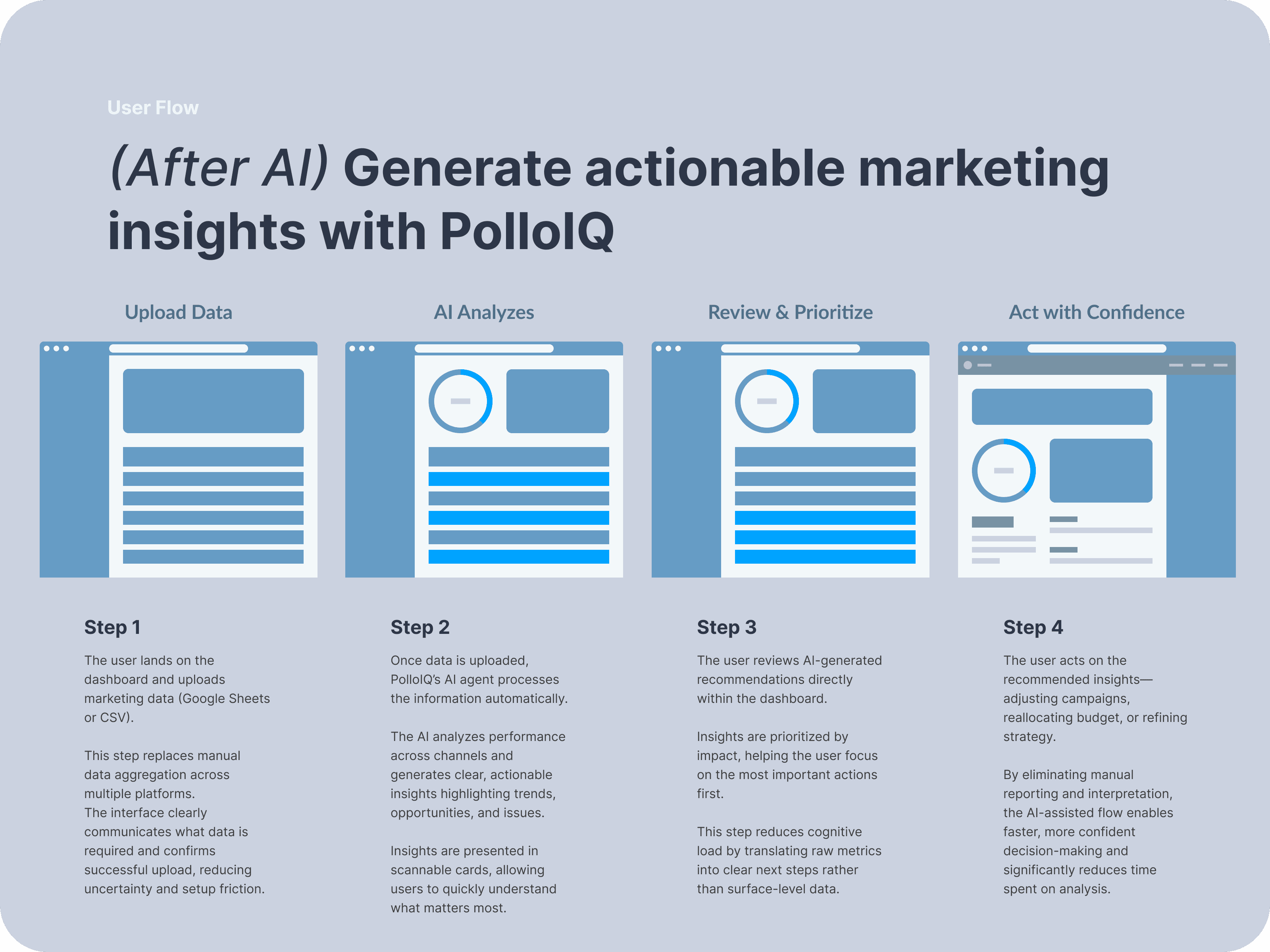
PolloIQ user flowsPolloIQ user flows 2

User Journey and Flows

I mapped the existing manual reporting workflow against an AI-assisted process to highlight improvements. The redesigned user journey focuses on three core tasks: uploading data, viewing AI-generated insights, and acting on recommendations. The flow emphasizes touchpoints where AI adds value, simplifying decision-making and reducing effort for marketing teams.

Core user actions:

  • Upload marketing data
  • Receive AI-generated insights
  • Act on prioritized recommendations
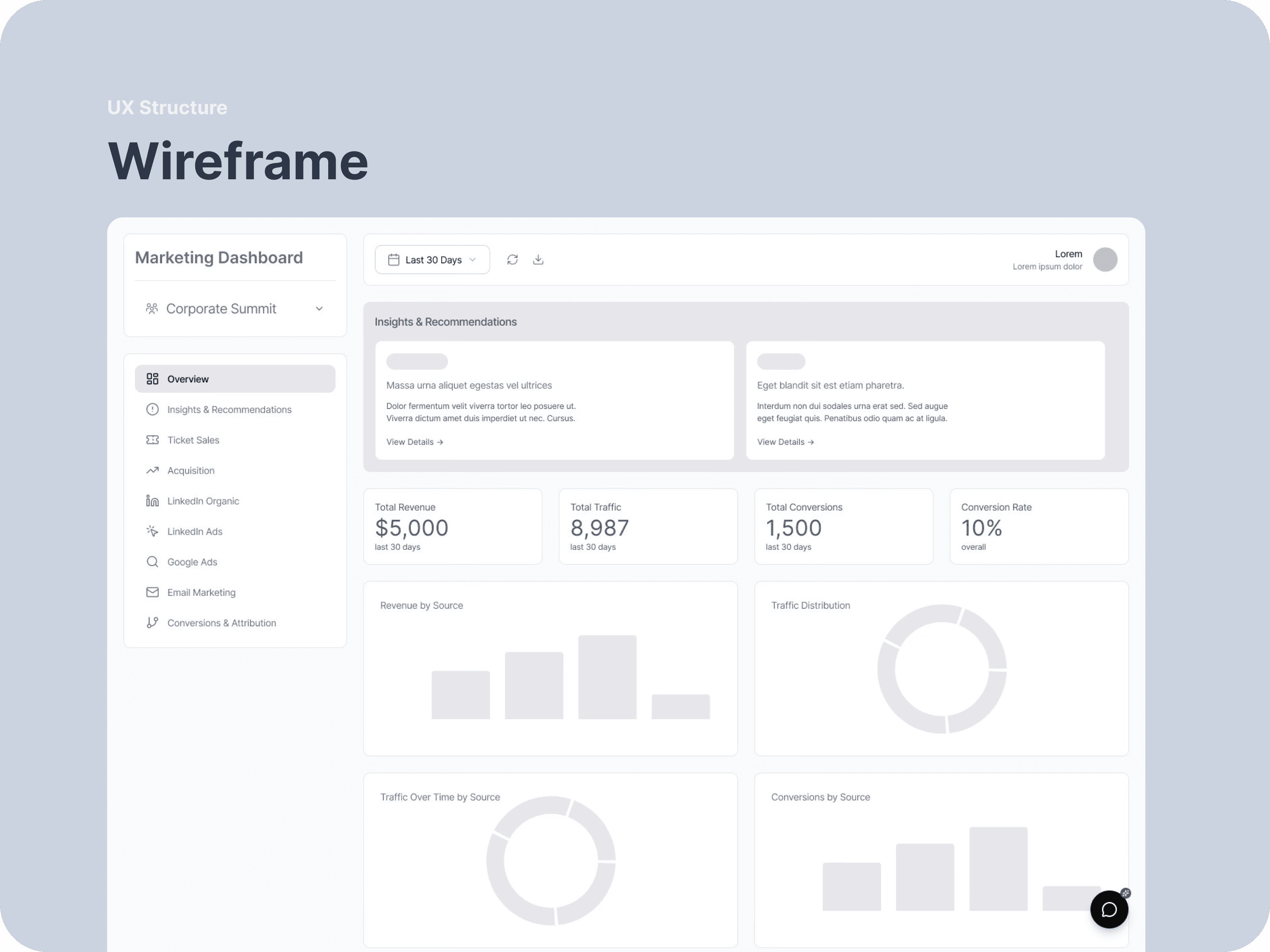
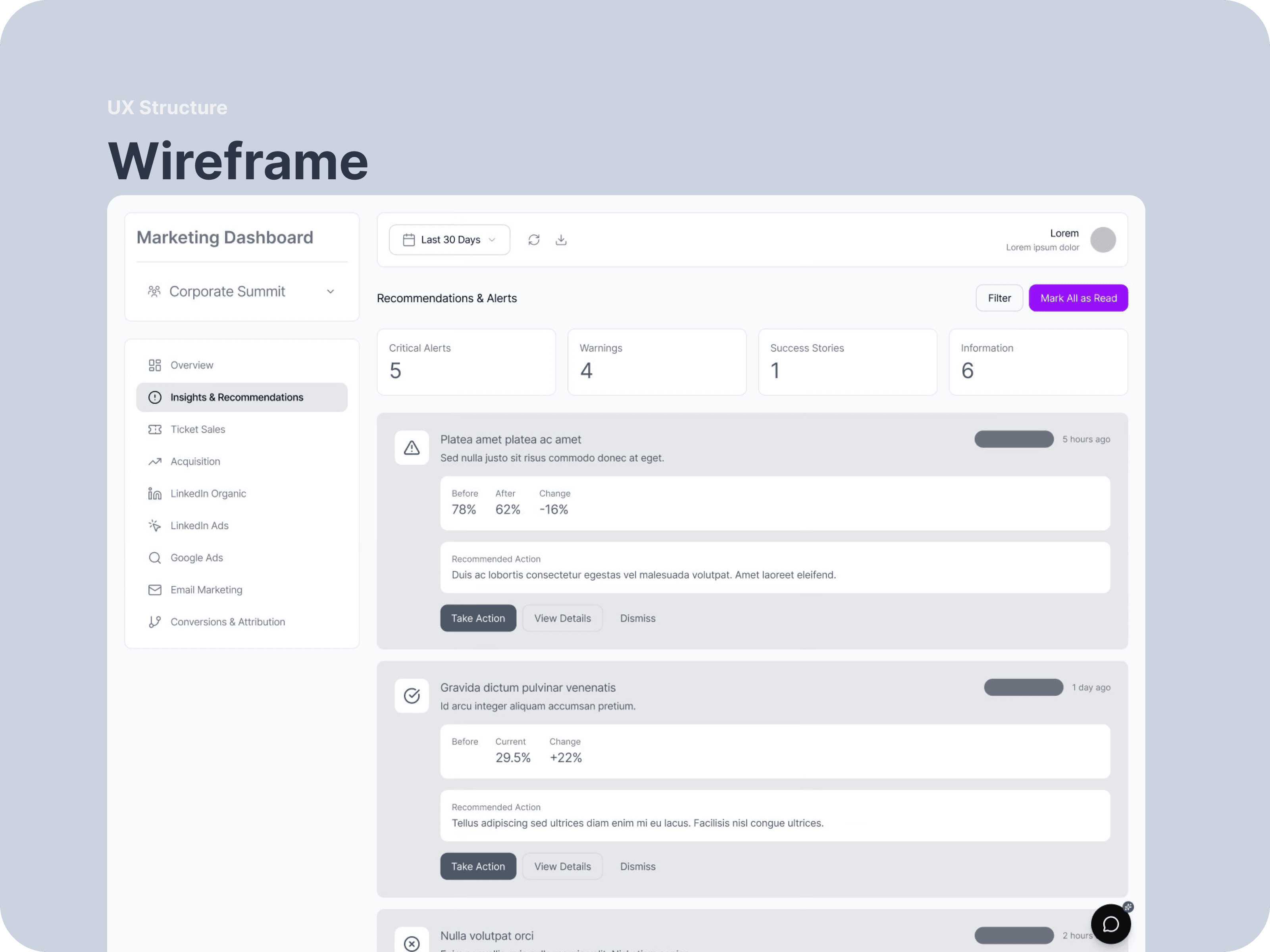
PolloIQ wireframePolloIQ wireframe 2

Information Architecture & Wireframes

The dashboard's structure was designed to prioritize clarity and actionable insights. Key sections include Campaign Overview, Channel Performance, AI Insights & Recommendations, and Alerts & Notifications. Low-fidelity wireframes guided layout and content hierarchy, emphasizing the importance of modular AI insight cards and interactive elements.

Core sections:

  • Campaign Overview
  • Channel Performance
  • AI Insights & Recommendations
  • Alerts & Notifications
PolloIQ design system

Design System

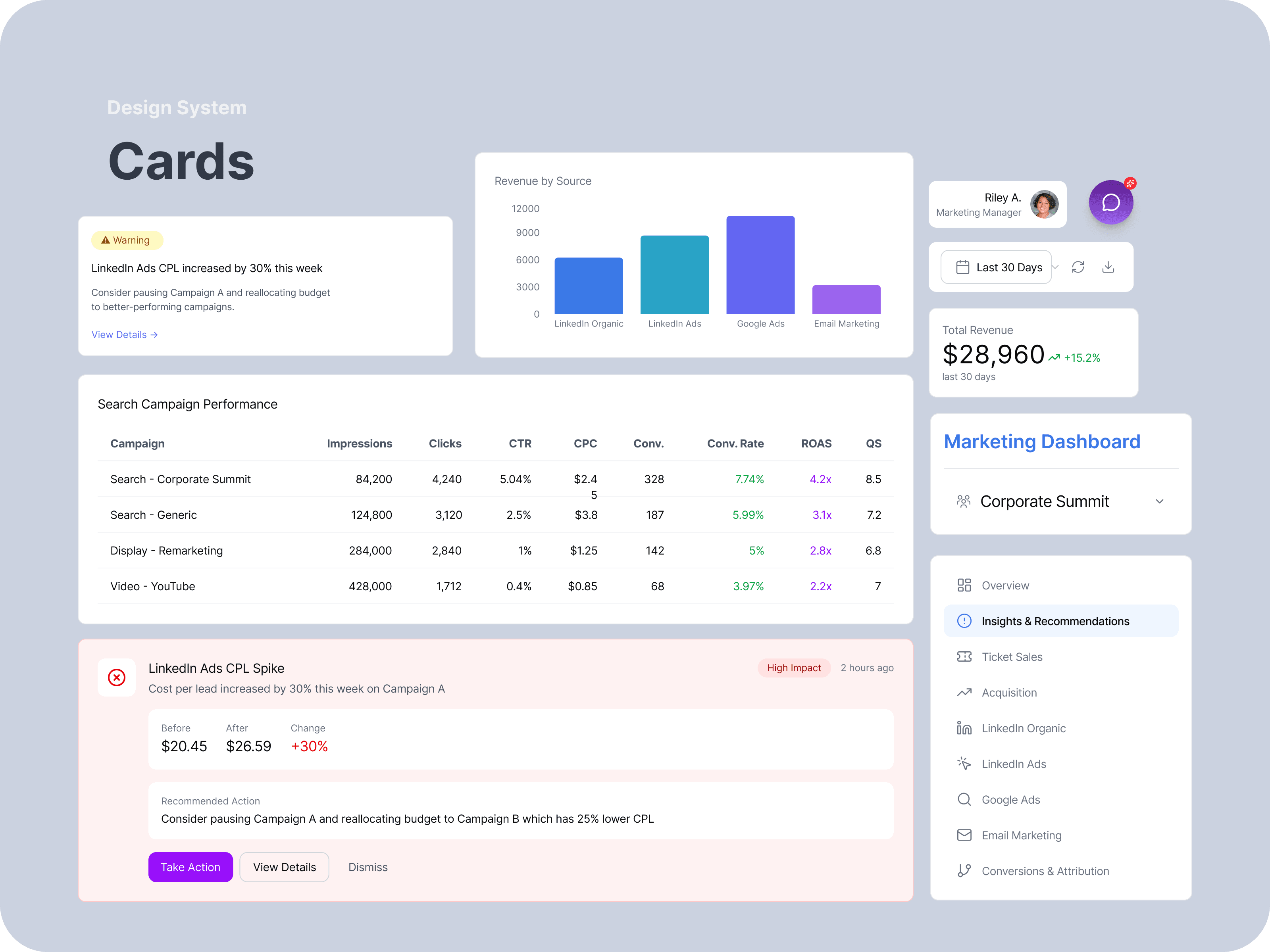
A modular design system was created to ensure consistency across the dashboard and support scalable interactions. Components included cards, tables, charts, typography, and a cohesive color system. Special attention was given to the AI insight cards to make recommendations easily scannable and actionable. The system allowed flexibility for future enhancements, including additional metrics, notifications, and multi-channel integrations.

Design system components:

  • Interactive AI insight cards
  • Charts and tables for clear data visualization
  • Consistent typography and color palette for readability

View live prototype.

PolloIQ high fidelity designsPolloIQ high fidelity designs 2

High Fidelity & Prototype

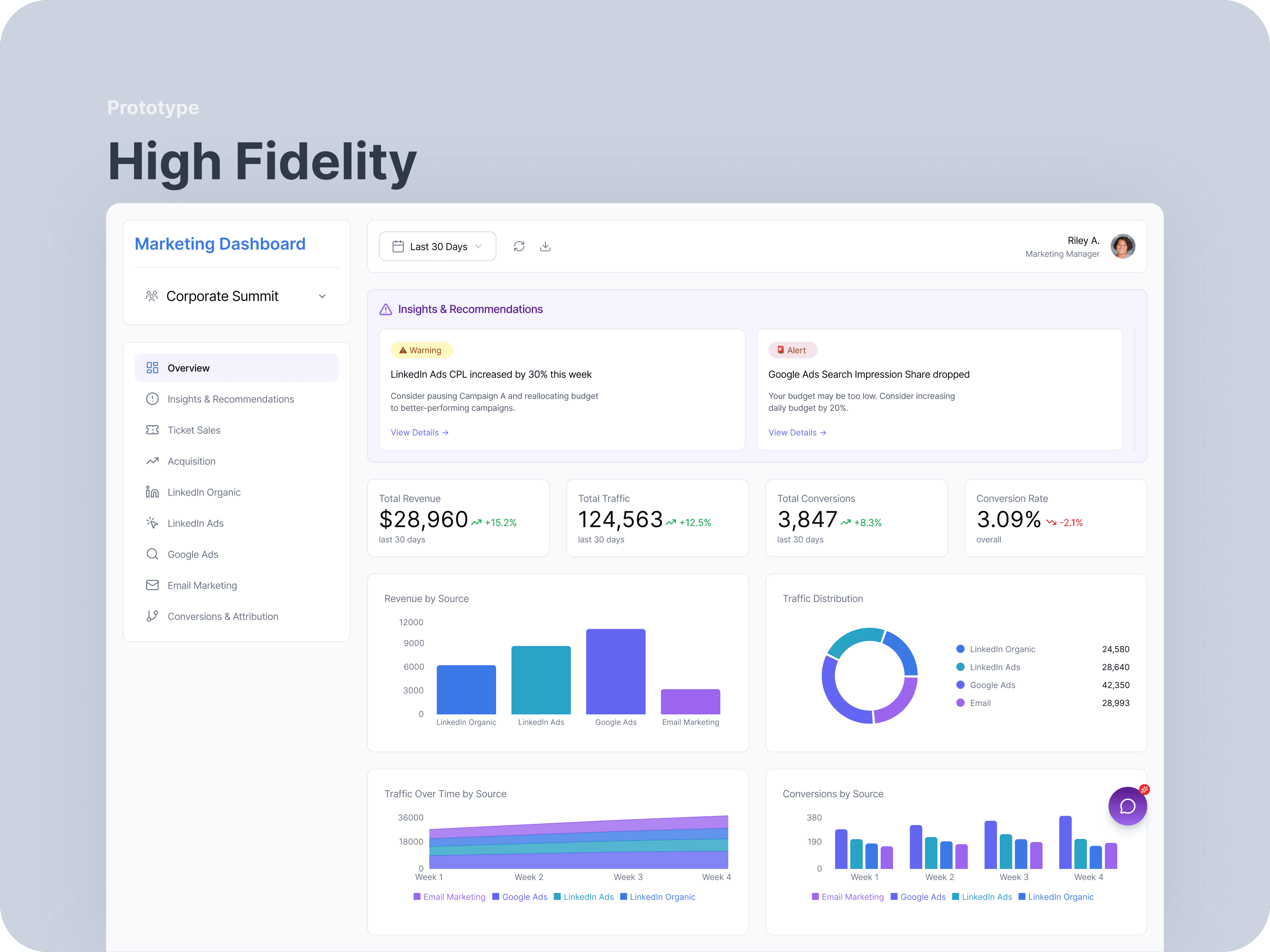
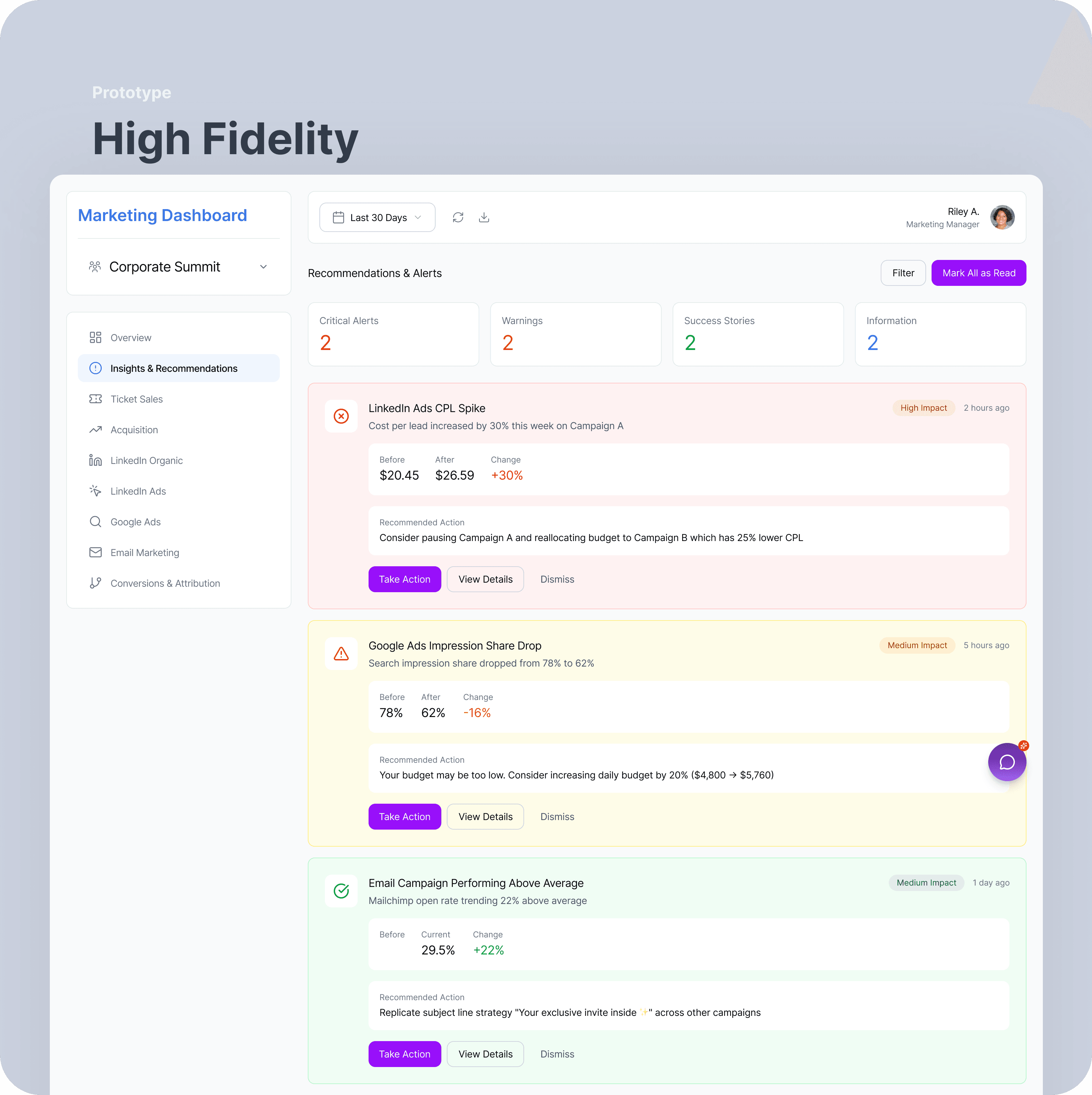
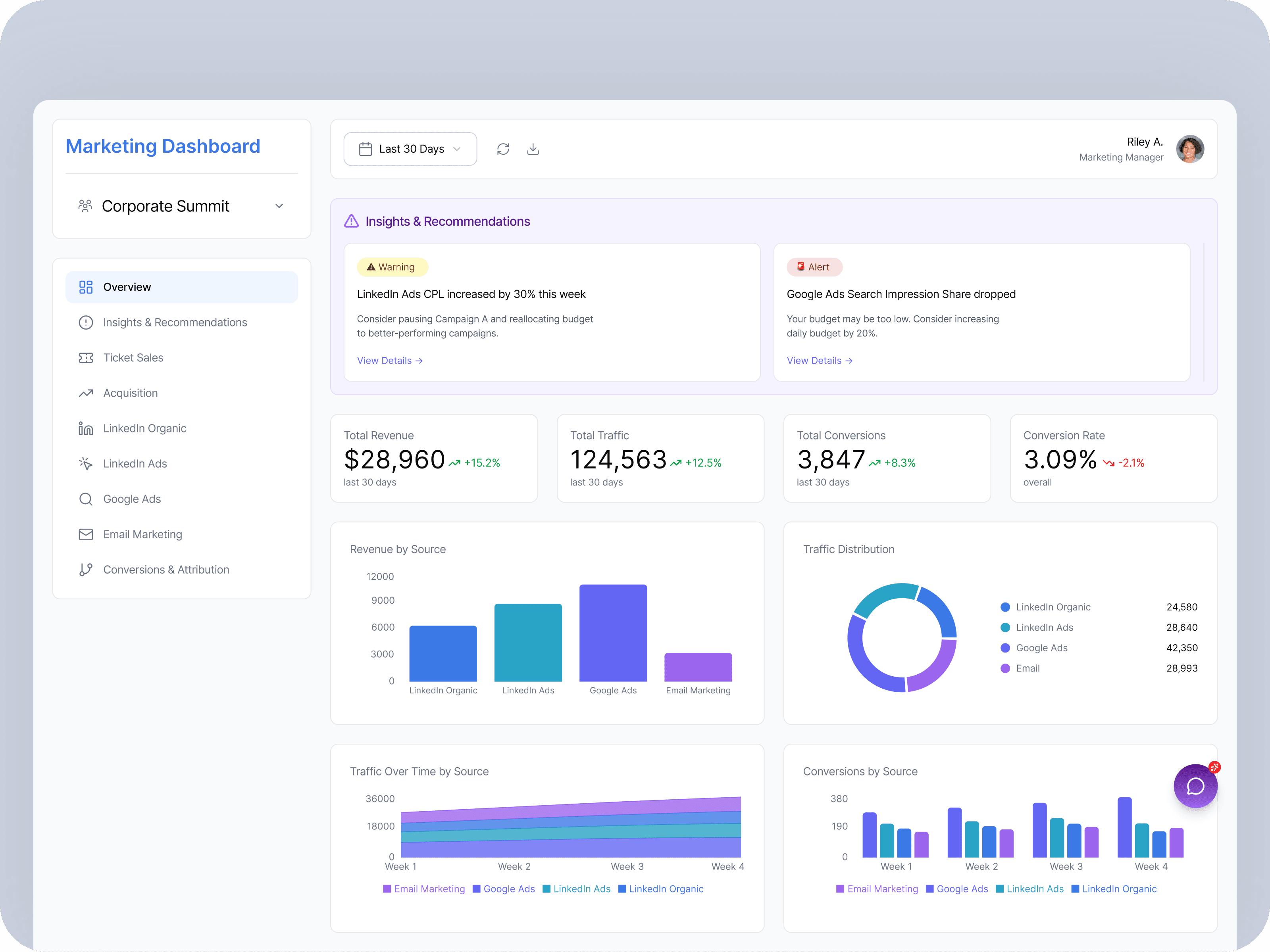
High-fidelity screens in Figma translated the design system into polished, user-friendly UI elements that clearly prioritized key metrics and actionable insights. The prototype showcases a Human-in-the-loop agentic workflow. By using Antigravity's context-aware logic, the system ensures that AI-generated insights are grounded in specific marketing protocols, resulting in ~20% faster decision-making for beta users. This setup enabled users to upload data, explore AI-generated insights, and act on recommendations seamlessly, demonstrating how automation and AI simplify the reporting workflow.

Key highlights:

  • Live AI insights powered by the ai agent integrated into the dashboard prototype
  • Interactive components simulate real user workflows, from data upload to insight exploration
  • Polished, modular UI supporting scalable AI-driven automation and actionable decision-making

The Impact

By transitioning from traditional data dashboards to an Antigravity-driven agentic framework, the system successfully analyzed real-time marketing data to generate autonomous, actionable insights. This Human-in-the-loop workflow enabled users to complete complex reporting tasks significantly faster than manual processes. Beta users reported that the agentic insights were highly relevant and context-aware—due to the specialized .md rule-sets defining the logic—resulting in reduced cognitive effort, improved visibility, and ~20% faster decision-making.

Key Learnings

Building PolloIQ reinforced the importance of combining automation with user-centered design. Even with powerful AI, clear UX/UI is essential to ensure usability and confidence. Future improvements include expanding AI capabilities for trend prediction, integrating live marketing APIs for real-time insights, adding notifications through Slack, email, or the dashboard, and conducting larger-scale testing with marketing teams for further iteration.

Next steps:

  • Integrate live marketing APIs (Google Ads, Meta Ads, HubSpot)
  • Enable proactive notifications (Slack, email, dashboard alerts)
  • Expand AI to trend prediction and multi-channel recommendations
  • Conduct broader user testing for feedback and refinement

Get In Touch

Let's discuss Senior Product Design, Agentic Workflows, or how I use Antigravity to solve complex business friction.